


Different opera portrayals of Guan Yu showcased at the Guan Gong Cultural Tourism Festival on Sept 23 in Yuncheng, Shanxi province. ZHU XINGXIN/CHINA DAILY
Every society has values it hopes will endure over time. They are written into stories, embodied by historical figures, and passed down through generations. But the true measure of those values is not whether people remember them, but whether they continue to shape how people live. In Shanxi province, two ideals have endured with particular strength: loyalty and righteousness.
They appear in temples and legends, and in the history of merchants who traveled thousands of kilometers from home to build businesses based on trust and reputation. They survive in ancient cities whose buildings reflect the communities that created them and in ongoing efforts to protect a remarkable cultural inheritance. Perhaps no figure embodies these ideals more powerfully than Guan Yu.
Born in what is now Yuncheng in southern Shanxi during the Eastern Han Dynasty (25-220), Guan Yu was a military general whose life became intertwined with legend. His loyalty to the warlord Liu Bei and reputation for courage and righteousness transformed him over the centuries from a historical figure into one of Chinese culture's most recognizable symbols.
Temples dedicated to him eventually appeared across China and far beyond its borders. To generations of Chinese people, he became known as Guandi, revered as an embodiment of loyalty, righteousness, integrity, and courage.

The bell tower at Yong'an Temple. MICHAEL CARD/CHINA DAILY
Yet to understand why those ideas matter to Shanxi, it is worth looking beyond the legend. Because the values associated with Guan Yu did not remain confined to temples; they became part of the identity of the province that produced him.
A legacy in stone
Nowhere is that connection clearer than at the Guandi Temple in Yuncheng. Close to Guan Yu's birthplace, the vast temple complex grew over successive dynasties into one of the most significant places dedicated to his memory.
Walking through its courtyards today, the complex's scale shows how the memory of one man grew over centuries. Gates, halls, stone inscriptions, and ancient trees create a physical record of the reverence afforded to him. But what is most interesting about such places is not simply their age or architecture, but why they survived. A temple can preserve a building, but it can also preserve an idea.
Generations came here because Guan Yu represented qualities they believed mattered. Loyalty was a commitment to others. Righteousness meant behaving according to principles rather than immediate self-interest. Trust, honor and keeping one's word became qualities associated with his name. Those principles proved especially important as people from Shanxi began traveling far beyond the province.

The pagoda in Yuanjue Temple in Datong. MICHAEL CARD/CHINA DAILY
Bonds beyond borders
Centuries after Guan Yu lived, Shanxi became famous for another group of people: its merchants. The Shanxi merchants, or jinshang, developed commercial networks that stretched across China and beyond. Their success rested on business skill and the ability to recognize opportunity, but commerce over such enormous distances posed a basic problem.
How do you do business with someone hundreds or thousands of kilometers away in a world without instant communication, electronic payments, or modern legal systems? The answer depended heavily on trust.
For merchants separated from their hometowns for long periods, reputation had real economic value. Honoring agreements, maintaining credibility, and building relationships were not abstract moral concepts. They were essential to doing business.
The ideals associated with Guan Yu therefore found a natural place within merchant culture. Guandi temples and shrines appeared along trading routes and within merchant communities, providing a shared cultural reference for people whose livelihoods depended on trust. Here, loyalty and righteousness moved from philosophy into everyday economic life. Perhaps the most remarkable expression of this can be seen in Pingyao.
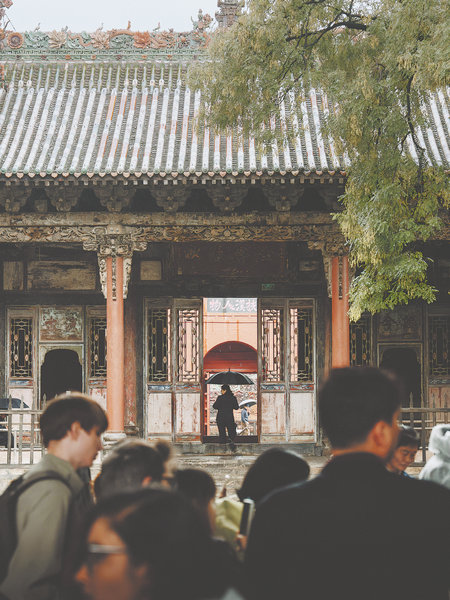
Visitors exploring Guandi Temple in Yuncheng. MICHAEL CARD/CHINA DAILY
Integrity as capital
Today, Pingyao Ancient City is known for its extraordinarily well-preserved walls, courtyards and streets. In the 19th century, it became one of China's most important financial centers.
In 1823, Rishengchang was established to become China's first piaohao, or draft bank. Its system allowed money deposited in one place to be withdrawn elsewhere, reducing the need for merchants to transport large quantities of silver across dangerous distances.
Standing inside Rishengchang today, it is easy to focus on the ingenuity of the financial system. Yet underneath that innovation was something much older: confidence that promises would be honored. A draft was ultimately a piece of paper whose value depended upon trust in the institution and the people behind it.
The rise of Shanxi banking offers an interesting connection between ancient ideals and economic development. Loyalty and righteousness were not merely virtues celebrated in stories. In a commercial society, integrity could become a form of capital. That idea remains strikingly modern.
Technology has transformed how business is conducted, but every financial system still depends on confidence. Contracts, banks, digital payments, and international trade all function because people believe obligations will be fulfilled. The methods change, but the underlying principle does not.
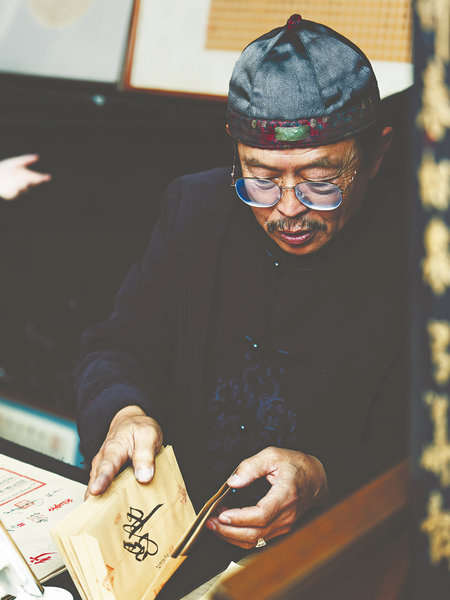
A performer plays the role of a banker in a show in Pingyao. MICHAEL CARD/CHINA DAILY
Ideals made visible
Another place that helps tell this story is the Qiao Family Compound in Qi county. Its courtyards, gateways and elaborate architecture demonstrate the wealth accumulated by Shanxi merchant families. Still, the compound also reveals something more intimate: how commercial success, family identity, education, and moral values coexisted. This is one reason Shanxi's surviving architecture matters.
Old buildings are sometimes treated as though their primary value lies in their beauty. But architecture can also record how people organized their lives. Merchant compounds, temples, guild halls, and ancient streets tell us what communities valued and how those values moved between family, society and business.
Together, places such as the Guandi Temple, Pingyao and Shanxi's merchant compounds tell different chapters of the same story. One preserves the ideals themselves. Another shows those ideals operating across vast commercial networks. Another reveals how the wealth and society created through those networks shaped everyday life.
The connection is not perfect or simple. History rarely is. Merchants were motivated by profit as well as principle, and the historical Guan Yu was inevitably more complicated than the figure remembered through centuries of storytelling. But that complexity makes the story more meaningful, not less. Cultures do not inherit values unchanged. Each generation interprets them according to its own circumstances.
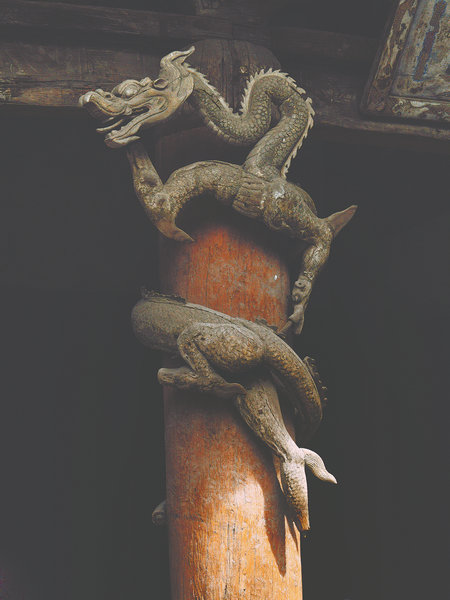
Details of dragon woodwork in Jinci Temple in Taiyuan. MICHAEL CARD/CHINA DAILY
Safeguarding memory
This is also why protecting Shanxi's heritage matters. The province possesses an extraordinary concentration of historic architecture. Its three UNESCO World Heritage Sites — Pingyao Ancient City, the Yungang Grottoes and Mount Wutai — are its most internationally recognized landmarks, but thousands of other historic structures survive across the province.
Preservation increasingly extends beyond simply repairing individual buildings. Shanxi has surveyed cultural relics, restored historic structures, protected ancient cities and villages, and used digital technologies to record vulnerable heritage.
Pingyao offers perhaps the clearest example of why this broader approach matters. Protecting only a handful of impressive courtyards would tell only part of its story. Its walls, lanes, shops, residences, temples, and financial institutions together allow visitors to understand how the city functioned.
The same is true of Guan Yu's legacy. Preserve only his name, and we lose the world that gave that name meaning. Preserve the temples, merchant towns, family compounds, documents, and traditions surrounding it, and the connections become visible. Heritage protection is not simply an attempt to prevent old things from disappearing. It protects memory.

A performer breathes fire at a molten iron fireworks show in Jinzhong. MICHAEL CARD/CHINA DAILY
Lessons for tomorrow
Modern Shanxi is very different from the province through which merchants once carried silver and goods. China itself has undergone a transformation those generations could scarcely have imagined. Yet rapid development makes looking backward even more important. History does not teach that modern societies should try to re-create the past. Nor should ancient virtues be repeated as slogans. Their value lies in asking what they mean under new circumstances.
What does loyalty mean in a society where people and businesses interact across borders? What does righteousness mean when economic decisions can affect communities thousands of kilometers away? What value should we place on reputation, responsibility and keeping our word? Modern answers may exist, but the questions themselves are ancient. That is what makes Shanxi such a powerful place to explore them.
From Guan Yu's hometown in Yuncheng to the courtyards of Pingyao and the homes of the merchants who helped build one of China's great commercial traditions, the province demonstrates how ideas can travel through time. They begin as principles, become stories, influence behavior, and eventually help shape institutions and communities.
Buildings can survive for centuries, but history's most important inheritance is not made from wood, brick or stone. It is the values people choose to carry forward.
And in Shanxi, loyalty and righteousness offer a thread connecting an ancient general, generations of merchants and bankers, and the province of today. Protecting the places where that story unfolded allows us to understand not only where those values came from, but why they still matter.
 Editor:Cai Xiaohui


